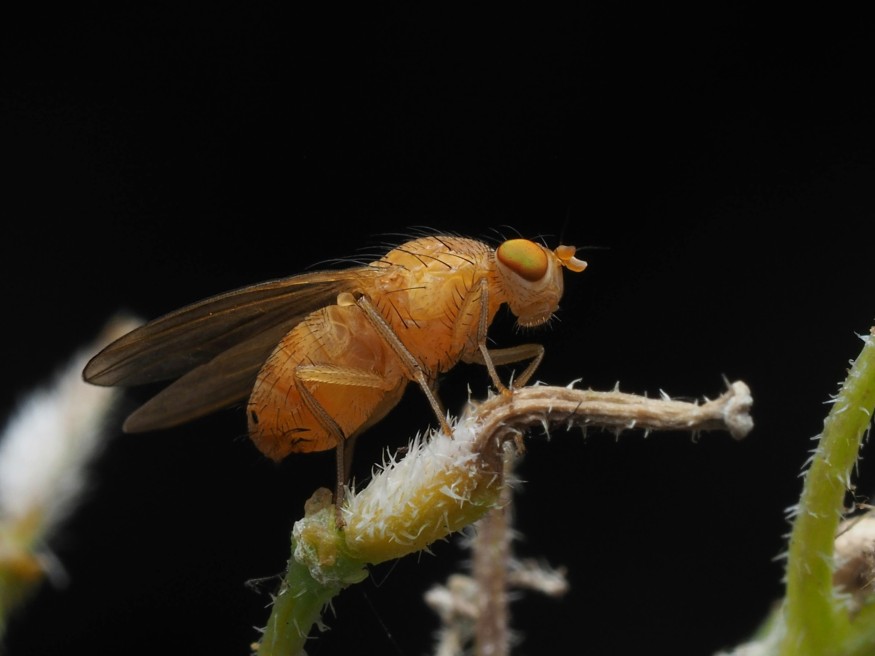
Most people associate fruit flies with kitchens, garbage bins, or bowls of overripe bananas. Scientists, however, recently highlighted a species that completely overturns that familiar image. Known as Drosophila enhydrobia, this rare underwater fruit flyevolved into a predator capable of hunting beneath the surface of flowing streams. Researchers say the insect's unusual lifestyle makes it one of the strangest members of the fruit fly family ever studied.
The Underwater Fruit Fly That Defied Expectations
Fruit flies usually survive on fermenting fruit, fungi, and decaying plant material. That is why scientists were stunned to find that Drosophila enhydrobia had evolved into an aquatic hunter instead.
According to a recent report published through Phys.org, the larvae of this underwater fruit fly spend their early life completely submerged in flowing streams. Instead of feeding on fruit, they prey on other aquatic organisms. Researchers described the behavior as highly unusual because predatory lifestyles are extremely rare within the Drosophila group.
What makes the discovery even more fascinating is that the species had not been seen in the wild since 1981. Scientists relied on preserved museum specimens to unlock the mystery surrounding the insect's evolution.
Unlike common fruit flies that thrive around human environments, Drosophila enhydrobia adapted to a harsh aquatic habitat where survival required completely different strategies.
Why Scientists Call It a Bloodthirsty Fruit Fly
The phrase "bloodthirsty fruit fly" quickly grabbed public attention, but researchers use the term to emphasize the insect's aggressive predatory behavior. During the larval stage, the underwater fruit fly actively hunts and consumes other small organisms living in streams. Scientists believe this dietary shift likely evolved because traditional food sources such as fermenting fruit were scarce in aquatic environments.
Researchers studying insect evolution explain that environmental pressure can force species to adapt in unexpected ways. Over time, Drosophila enhydrobia appears to have abandoned the scavenging behavior typical of fruit flies and instead developed hunting instincts better suited for underwater survival.
Several characteristics make the species stand out:
- It spends its larval stage underwater
- It hunts live prey instead of feeding on rotting fruit
- It survives in fast-moving stream habitats
- It evolved specialized sensory adaptations
The findings also suggest the insect's body and genetic systems became increasingly specialized over generations.
Strange Adaptations Helped the Fly Survive Underwater
Living underwater presents enormous challenges for insects. Oxygen is limited, currents are dangerous, and detecting prey beneath the surface requires different sensory abilities.
Scientists discovered that Drosophila enhydrobia evolved several adaptations that allowed it to survive in aquatic habitats. Research published in Current Biology indicated that the species lost multiple genes commonly found in ordinary fruit flies, particularly genes related to smell and taste.
While losing genes might sound harmful, researchers believe the opposite happened. By eliminating unnecessary sensory functions, the underwater fruit fly became more specialized for life in streams.
Scientists think the remaining genes became highly refined, helping the species detect movement, prey, and environmental changes underwater.
The insect's adaptations likely include:
- Improved underwater sensory processing
- Better movement control in flowing water
- Predatory feeding behavior
- Enhanced survival in low-oxygen environments
According to evolutionary biologists, this type of genetic specialization provides valuable insight into how species adapt to extreme habitats over long periods.
Museum DNA Helped Scientists Solve the Mystery
One of the most remarkable parts of the study involved how researchers obtained information about a species that had seemingly disappeared from scientific observation decades ago.
Scientists used preserved museum specimens stored in Zurich to extract DNA from Drosophila enhydrobia. Modern sequencing technology allowed them to study the insect's genome without damaging the rare samples.
Researchers then compared the genome with related fruit fly species to trace its evolutionary history. Their findings showed that the underwater fruit fly belongs to a lineage associated with water-adapted flies from South Asia.
The research also highlighted the growing importance of museum collections in modern science. Specimens gathered decades ago are now helping scientists answer complex evolutionary questions using advanced genetic tools.
A report from ScienceDaily discussing the research noted that museum-based DNA studies are becoming increasingly valuable for understanding rare or missing species. Meanwhile, entomologists interviewed by New Scientist emphasized how unusual it is for a fruit fly to evolve a fully aquatic predatory lifestyle.
These discoveries demonstrate that museum collections may still contain countless biological secrets waiting to be uncovered.
Read Also: Scientists Discover Dinosaur Colors and Hidden Dinosaur Color Patterns Lost for Millions of Years
What the Discovery Reveals About Evolution
The underwater fruit fly provides scientists with a unique example of extreme evolutionary adaptation. Most species evolve gradually within the limits of their existing lifestyle, but Drosophila enhydrobia appears to have undergone dramatic behavioral and ecological changes.
Researchers believe the species adapted because aquatic habitats created strong environmental pressures. Food availability, water movement, oxygen levels, and competition likely influenced how the insect evolved over time.
The study supports several important ideas in evolutionary biology:
- Species can dramatically change feeding behavior
- Gene loss may sometimes improve survival
- Extreme environments encourage specialization
- Small insects can evolve highly complex adaptations
Scientists are especially interested in how sensory systems evolved in the underwater fruit fly. Because water changes how organisms detect chemicals and movement, aquatic insects often require very different biological tools compared to land-based species.
Understanding these changes may help researchers study adaptation in other animals facing environmental shifts.
Strange Facts About Drosophila enhydrobia
Here are some of the most surprising facts about this unusual species:
- It is one of the few known aquatic fruit flies
- Its larvae behave like underwater predators
- The species has not been documented in the wild since 1981
- Scientists reconstructed its history using museum DNA
- It evolved by losing several common fruit fly genes
- Researchers believe it became highly specialized for stream habitats
The insect's story also highlights how much remains unknown about biodiversity. Even familiar insect groups such as fruit flies may contain species with behaviors scientists never expected.
How the Underwater Fruit Fly Is Changing Scientific Research
The rediscovery of Drosophila enhydrobia may influence future studies involving evolution, ecology, and genetics. Scientists are increasingly interested in how species adapt to environmental stress and habitat changes. The underwater fruit fly offers a rare opportunity to examine how behavior, genetics, and habitat can evolve together over time.
Researchers also believe similar undiscovered species may exist in poorly studied ecosystems around the world. Advances in DNA sequencing could make it easier to identify rare organisms from old museum collections or environmental samples.
The bloodthirsty fruit fly serves as a reminder that evolution does not always follow predictable patterns. Sometimes even a tiny insect can develop traits that completely reshape scientific understanding of an entire group.
What Scientists Are Still Trying to Understand
Although researchers uncovered important details about the species, many questions remain unanswered.
Scientists still hope to learn:
- Whether the species still exists in the wild
- How its larvae hunt underwater
- What prey it prefers
- How its respiratory system functions underwater
- Whether related species share similar adaptations
Future field studies may eventually provide answers, especially if researchers locate surviving populations in aquatic habitats.
What the Bloodthirsty Fruit Fly Says About Nature
The story of Drosophila enhydrobia demonstrates how flexible evolution can be under extreme environmental pressure. A creature once associated with fruit and fermentation adapted into an underwater hunter capable of surviving in flowing streams.
Its rediscovery through museum DNA analysis also shows how scientific breakthroughs can emerge from preserved specimens collected decades earlier. As genetic technology continues improving, researchers may uncover many more hidden examples of unusual adaptation across the natural world.
The underwater fruit fly stands as one of the clearest reminders that even tiny insects can evolve extraordinary survival strategies that challenge long-standing scientific assumptions.
Frequently Asked Questions
1. What is Drosophila enhydrobia?
Drosophila enhydrobia is a rare underwater fruit fly species known for its aquatic predatory lifestyle.
2. Why is it called a bloodthirsty fruit fly?
Scientists use the phrase because the larvae actively hunt and feed on other organisms instead of eating rotting fruit like ordinary fruit flies.
3. Can fruit flies really survive underwater?
Most fruit flies cannot, but Drosophila enhydrobia evolved special adaptations that allow its larvae to live in aquatic stream habitats.
© 2026 NatureWorldNews.com All rights reserved. Do not reproduce without permission.


