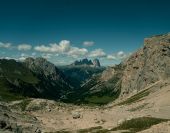
Most people's first reaction to the Dolomites is confusion. If you've hiked elsewhere in the Alps—the Mont Blanc massif, the Bernese Oberland, the Ecrins—you expect certain things.
Rounded granite peaks, glaciers spilling down valleys, green slopes giving way to grey rock and ice.
The Dolomites don't play by those rules. They're vertical, angular, almost architectural. The rock is pale, sometimes nearly white, and it rises in sheer walls that look more like the work of a sculptor than geology.
It's All About the Rock
The difference comes down to what these mountains are made of. Most of the Alps are granite, gneiss, and other metamorphic rocks formed deep underground under immense pressure. These are hard, ancient rocks that erode gradually into the rounded, glaciated shapes we associate with classic Alpine terrain.
The Dolomites are made of dolomite rock—a type of limestone rich in magnesium. But the really interesting part is where this rock came from. About 250 million years ago, this area wasn't mountains at all.
It was a shallow tropical sea. The pale rock that now towers thousands of meters above sea level started as coral reefs, similar to the Great Barrier Reef today.
How Coral Reefs Became Mountains
The fossilized reefs and lagoon sediments accumulated over millions of years. Eventually, tectonic forces pushed the African plate into the European plate, crumpling the seabed and lifting these ancient reefs skyward. But unlike other Alpine rock that got heated and compressed into metamorphic forms, the dolomite remained relatively unchanged.
This is why the rock retains its layered, sedimentary structure. You can often see distinct horizontal bands in the cliff faces—evidence of different periods of reef growth and sediment deposition. It's also why fossils are common here, though you need to know where to look.
Why the Peaks Are So Dramatic
Dolomite rock erodes in a specific way. It's harder than regular limestone but still soluble in slightly acidic water. Over millennia, water seeps into cracks, freezes, expands, and breaks off chunks along vertical fractures.
This creates the characteristic towers, spires, and sheer walls. Where granite mountains erode into curves, dolomite shatters into geometric forms. The result is those impossible-looking peaks that seem to defy physics.
The Color Changes Everything
The pale, almost luminous quality of dolomite rock creates an entirely different atmosphere than granite Alps. In full sun, the rock can be nearly white, almost painful to look at. In shadow, it turns dove grey.
But the real magic happens at sunrise and sunset. The phenomenon called "enrosadira"—from the Ladin word for turning pink—transforms the peaks into glowing rose and orange towers. It happens because the dolomite's mineral composition reflects red wavelengths particularly well during the golden hour.
Watching the Mountains Glow
You haven't really experienced the Dolomites until you've watched enrosadira. The effect lasts maybe fifteen or twenty minutes as the sun hits the rock at just the right angle. The peaks seem to light up from within, shifting from pale yellow to deep orange to purple-pink before fading to grey as the sun drops below the horizon.
Many Dolomites hiking tours time their itineraries specifically to catch this phenomenon from strategic viewpoints. It's the kind of natural spectacle that makes you understand why people become obsessed with these mountains.
The Landscape Feels Different
Beyond the rock itself, the Dolomites create a different kind of hiking experience. The extreme verticality means you're often walking through meadows or forests with massive walls rising directly overhead. There's less of the gradual elevation gain you get in other parts of the Alps.
Routes here frequently involve cables, ladders, and sections of scrambling—not quite climbing, but more technical than standard hiking. The via ferrata system originated here out of necessity, because how else do you move through terrain this vertical?
The Meadows and Forests Below
The contrast between the brutal rock architecture above and the gentle landscapes below is striking. Alpine meadows here are lush and flower-filled in summer. The forests are dense stands of spruce and larch that turn golden in autumn.
This creates constantly changing scenery. You might spend two hours walking through pastoral valleys, then round a corner and find yourself at the base of a 500-meter vertical wall. The scale shifts abruptly in ways that keep the landscape visually interesting.
Weather Behaves Differently Here
The vertical rock faces create their own microclimates. Clouds build rapidly against the walls, and afternoon thunderstorms are common in summer. The bare rock heats up quickly in sun, creating strong updrafts that can brew weather seemingly out of nowhere.
Mornings tend to be clearer and more stable. This is another reason experienced hikers here start early—not just for the light, but for safer weather windows.
Why This Matters for Hiking
Understanding the geology changes how you approach these mountains. You're not dealing with glaciers and ice the way you are in much of the Alps. The hazards here are different—rockfall, exposure, sudden weather, and routes that require more technical skill than elevation might suggest.
The reward is landscapes that feel almost alien in their drama. These mountains don't have the savage, ice-covered grandeur of the Mont Blanc range. They have something else—a stark, sculptural beauty that photographs can't quite capture.
The Human Scale of It
Despite their dramatic appearance, the Dolomites are surprisingly accessible. The network of mountain huts means you can tackle serious routes without carrying camping gear. The trails are well-maintained, and the via ferrata system opens up terrain that would otherwise require climbing skills.
But accessible doesn't mean tame. These mountains demand respect and proper preparation. The vertical relief is real, the exposure is legitimate, and the weather can turn hostile quickly.
Mountains That Stick With You
Most people who hike the Dolomites end up comparing every other mountain range to them afterward. It's not that other ranges are worse—they're just different. Once you've walked beneath those pale towers and watched them glow at sunset, other mountains can feel almost ordinary by comparison.
The Dolomites don't look like the rest of the Alps because they fundamentally aren't like the rest of the Alps. They're ancient seabeds thrust skyward, sculpted by water and time into forms that seem almost too dramatic to be real. And that's exactly why they're worth experiencing.
© 2026 NatureWorldNews.com All rights reserved. Do not reproduce without permission.


