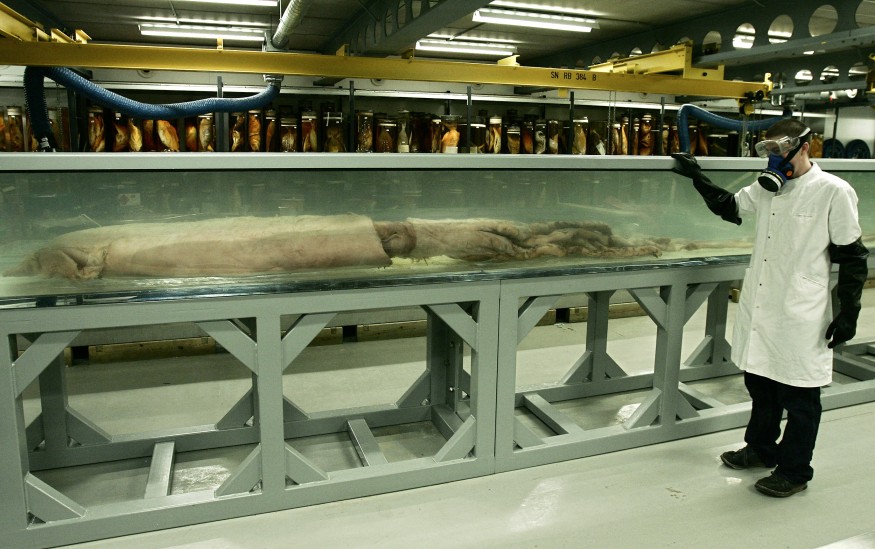
Scientists exploring deep underwater canyons off the coast of Western Australia have uncovered a hidden world of marine life — including evidence of the legendary giant squid — without ever seeing a single animal. Instead, they used a cutting-edge technique called environmental DNA, or eDNA, to detect the genetic fingerprints creatures leave behind in the water as they go about their lives.
The study, published in the journal Environmental DNA in early 2026 and led by Curtin University in Australia, identified 226 species from 178 water samples collected across five different depths — some reaching more than 4,500 meters below the surface. Among those species was genetic material linked to the giant squid (Architeuthis dux), a creature so rarely encountered that little is known about its biology, behavior, or population size.
It is the first record of the species in Western Australian waters using eDNA methods, and the northernmost confirmed record in the entire eastern Indian Ocean.
What Is Environmental DNA and Why Does It Matter?
Environmental DNA is one of the most exciting tools in modern biology. As animals swim, breathe, feed, and shed cells through skin, mucus, and waste, they leave tiny fragments of their genetic material behind in the water around them. Scientists can collect small water samples, filter out these fragments, and then sequence the DNA to identify which species were recently present — without ever capturing, photographing, or directly observing a single animal.
This matters enormously for studying the deep ocean. The deep sea is one of the least-explored environments on Earth. It is remote, expensive to reach, and pitch dark. Traditional survey methods, such as trawling with nets or deploying remotely operated vehicles, are costly, time-consuming, and can only cover a small area at any one time.
eDNA changes that equation. Researchers can collect water samples at multiple depths during a single expedition and later analyze them in a laboratory to build a remarkably detailed picture of what lives below.
What Was Found in Western Australia's Deep Canyons
The expedition, conducted aboard the Schmidt Ocean Institute's research vessel R/V Falkor, explored the Cape Range and Cloates submarine canyons located about 1,200 kilometers north of Perth near the Ningaloo Coast. These canyons plunge to depths of more than 4,500 meters and had been largely unexplored before this study.
The team from Curtin University, working alongside researchers from the University of Western Australia, the Western Australian Museum, the University of Tasmania, and several other institutions, collected 178 water samples across five depths. The analysis revealed 226 species from 126 different families.
Among the notable finds were deep-diving whales, a sleeper shark, a faceless cusk, and a slender snaggletooth — species rarely or never previously recorded in this part of the ocean. And in six separate water samples drawn from both canyons, researchers detected the genetic signature of the giant squid.
"We found a large number of species that don't neatly match anything currently recorded," said lead researcher Dr. Georgia Nester of Curtin University. "Which doesn't automatically mean they're new to science, but it strongly suggests there is a vast amount of deep-sea biodiversity we're only just beginning to uncover."
The researchers also noted that each depth zone had its own distinct set of species, and that the two canyons differed from each other in their biodiversity — suggesting that even within a relatively small area of ocean, life is far more varied and structured than previously appreciated.
Why This Discovery Matters Beyond the Headlines
Finding the giant squid is the kind of news that captures imaginations, but researchers say the broader findings of this study may be even more scientifically significant.
Deep-sea ecosystems face growing pressure from climate change, fishing operations, and proposals for deep-sea mining. Yet baseline surveys of what actually lives in these environments are scarce. Without knowing what species are present and where, it is impossible to meaningfully protect them or assess how human activities are affecting them.
"Environmental DNA gives us a scalable, non-invasive way to build baseline knowledge of what lives there, which is essential for informed management and conservation," Dr. Nester said. "You can't protect what you don't know exists."
The canyons explored in this study sit adjacent to the Ningaloo Marine Park, a UNESCO World Heritage Site known for its coral reefs and whale sharks. This new data could help inform how the park's protections are managed and extended into deeper waters.
Limitations of the eDNA Method
While environmental DNA is a powerful tool, it does have limitations that scientists are careful to acknowledge. The presence of an animal's DNA in the water does not necessarily mean the animal was present at the moment of sampling. DNA can drift with ocean currents, meaning a sample might reflect life from a broader area than just the collection point.
The method also cannot tell researchers how many individuals are present, what they were doing, or how healthy the population is. It gives a snapshot of presence, not a full portrait of a community.
Some of the potential new species detected may also turn out to be known species once their DNA is more carefully analyzed against existing databases, which are still incomplete for many deep-sea groups.
Despite these limits, eDNA remains one of the best tools available for surveying remote, difficult-to-access environments — and studies like this one are steadily filling in the enormous gaps in our knowledge of deep ocean life.
Source: Georgia M. Nester et al., "Environmental DNA Reveals Diverse and Depth-Stratified Biodiversity in East Indian Ocean Submarine Canyons," Environmental DNA, 2026. DOI: 10.1002/edn3.70261. Led by Curtin University.
© 2026 NatureWorldNews.com All rights reserved. Do not reproduce without permission.


