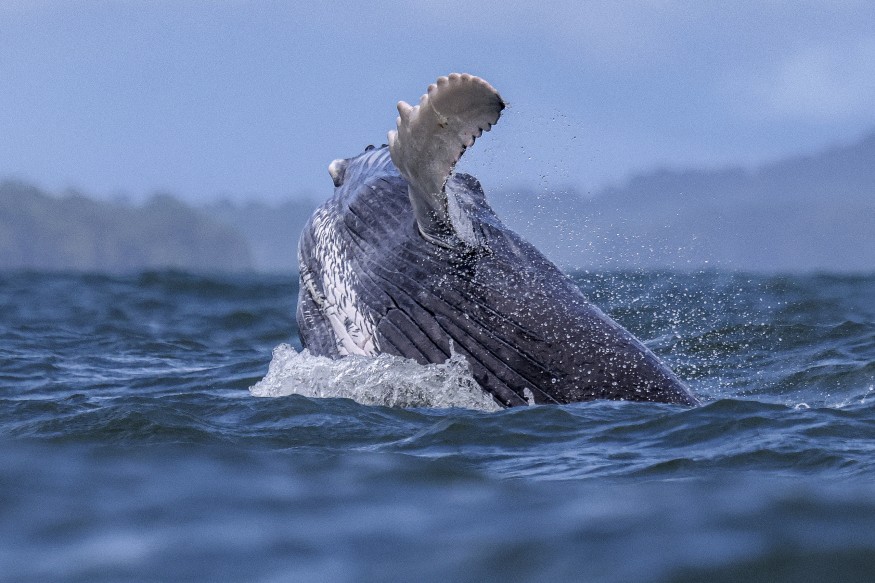
In one of the most remarkable wildlife discoveries of 2026, scientists have confirmed that two humpback whales made record-breaking journeys between breeding grounds in eastern Australia and Brazil — crossing more than 14,000 kilometers of open ocean. One of those whales traveled at least 15,100 kilometers between sighting locations, the longest confirmed distance ever recorded between sightings of the same humpback whale anywhere on Earth.
The findings, published in Royal Society Open Science in May 2026, represent the first documented proof that humpback whales have traveled between these two distant ocean basins — in both directions. The study was led by researchers at Griffith University in Australia, working alongside an international team from Brazil and the United States.
How Scientists Cracked the Case: Decades of Whale Tail Photos
The method behind this discovery is both simple and remarkable. Humpback whales have uniquely patterned tail fins, called flukes, much like human fingerprints. By comparing photographs of whale tails taken over four decades, scientists were able to match individual animals spotted on opposite sides of the world.
Researchers identified two individual whales that had been photographed in both eastern Australia and Brazil through photo-matching of tail flukes collected over four decades. The team analyzed more than 19,000 fluke photographs using an automated image-recognition program, with each match confirmed by hand.
One whale was first photographed in Hervey Bay, Queensland in 2007, and was seen again in the same area in 2013 before turning up off the coast of São Paulo, Brazil in 2019. These two breeding grounds are separated by a minimum straight-line ocean distance of about 14,200 kilometers — roughly the distance from Sydney to London.
The second whale traveled even farther. First recorded in Brazil in 2003, it was observed in Australia in 2025 after traveling about 15,100 kilometers, the longest such distance ever documented between sightings of the same humpback whale.
Because only the start and end points of each whale's journey were photographed, the true distances actually swum remain unknown. The whales may have taken long, winding routes that added thousands more kilometers to their travels.
Why This Matters: Genes, Songs, and Ocean Health
While the journeys themselves are stunning, what they mean for whale biology may be even more important. Humpback whales living in Australia and Brazil have long been considered separate populations. Occasionally, individuals crossing between those groups could have real effects on the health of both.
Occasional individuals moving between distant breeding grounds can help maintain genetic diversity across populations and may even carry new song styles from one region to another. Humpback whale songs are known to spread culturally across ocean basins, much like music trends in human populations.
In other words, these wandering whales are not just breaking records. They may serve as living links between otherwise isolated whale communities, carrying both genes and cultural traditions across two oceans.
Researchers also note that this kind of extreme, rare travel may become slightly more common over time. Climate change could also be a factor, and may result in more instances of large distances covered by humpbacks as conditions continue to change, including ice shifts and the distribution of Antarctic krill, the creature's main prey.
This does not mean such crossings will ever become routine. Resighting intervals of 6 and 22 years suggest that these are rare, possibly single-lifetime events rather than regular migratory shifts.
What the Study Does Not Prove
It is worth being clear about the limits of what this research shows. Because scientists only photographed each whale at its starting and ending points, no one tracked the actual route either animal took. The 14,200-kilometer and 15,100-kilometer figures represent the shortest possible straight-line distance between sighting locations — the real distance swum could be significantly greater.
The study also cannot tell us why these particular animals chose to make such extreme journeys. Researchers can only document that they did. Whether food availability, breeding competition, or some other factor drove these movements is still an open question.
Additionally, the study is based on just two confirmed individual whales over four decades of records. That makes these events genuinely rare. Scientists are careful to note that this is not evidence of a new migration pattern taking hold across the species.
A Triumph for Long-Term Science and Global Teamwork
Perhaps one of the most encouraging parts of this story is how the discovery was made possible. "Discoveries like this are only possible because of investment into long-term multi-decadal research programs and international collaboration," said Griffith University PhD candidate and co-lead author Stephanie Stack.
Photo-identification databases built up over decades by researchers and citizen scientists in multiple countries made it possible to connect a whale photographed in Queensland to one spotted off São Paulo years later. Without those long-running, unglamorous data-collection efforts, the story of these two extraordinary animals would never have been told.
For ordinary ocean lovers, this discovery is a good reminder that the world's seas are far less divided than maps suggest. Two oceans, a continent apart, are connected by creatures navigating by instinct, memory, and perhaps the stars — on journeys that dwarf almost anything else in the animal kingdom.
Source: Cristina Castro Ayala et al., "First evidence of bidirectional exchange between distant humpback whale breeding populations in eastern Australia and Brazil," Royal Society Open Science, May 2026. DOI: 10.1098/rsos.260251.
© 2026 NatureWorldNews.com All rights reserved. Do not reproduce without permission.


