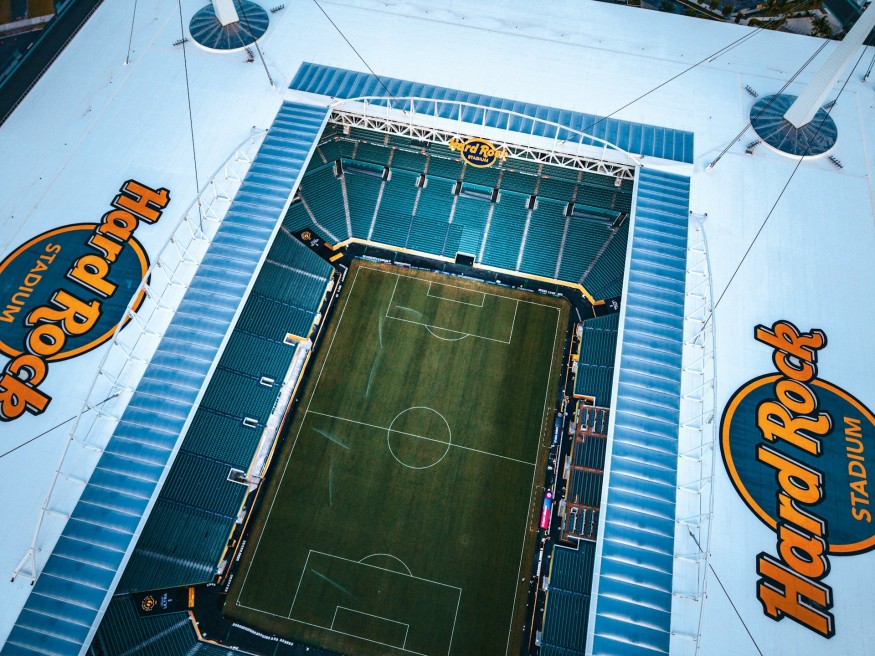
Seven World Cup matches — including a quarterfinal and the third-place consolation match — will be played at Hard Rock Stadium in Miami Gardens, Florida, from June 16 through July 18, 2026. On paper, this is a triumph for South Florida's sports and hospitality economy. In the laboratories of climate scientists, epidemiologists, and sports physiologists, it is something that has generated a sustained, urgent warning for months: Miami has emerged as the most climatically dangerous of all 16 World Cup venues on the planet.
A landmark analysis by Climate Central published this week found that extreme June–July heat is currently most common — more than any other host city in the world — at stadiums in Miami, Mexico City, Houston, and Guadalajara. Hard Rock Stadium and Houston's NRG Stadium lead the hemisphere. Climate change driven by fossil fuel combustion accounts for 49% of all extremely hot June–July days since 1970, on average, across all 16 World Cup stadium sites. Most staggeringly: the frequency of extremely hot June–July days has tripled across the North American host cities since the continent last hosted the tournament in 1994. In 32 years, the atmosphere above these stadiums has fundamentally changed — and the consequence, as a team of 15 World Weather Attribution researchers concluded, is that grueling heat and humidity are dramatically more likely to affect this year's tournament than the 1994 event held on the same continent.
What Happened at Hard Rock During the Club World Cup — A Preview
South Florida had a direct preview of what full World Cup heat looks like during the FIFA Club World Cup in June 2025, played at many of the same North American venues. At Hard Rock Stadium, Juventus manager Igor Tudor revealed that ten players asked to be substituted during a match against Real Madrid in Miami, where temperatures reached 30°C with 70% humidity. Chelsea midfielder Enzo Fernández described conditions as "very dangerous," adding that "everything becomes very slow." A star Uruguay player left a Miami match at halftime, later reporting dizziness and dehydration. These were not marginal athletes pushed beyond ordinary exertion — these were the best-conditioned professional footballers in the world, failing to compensate for environmental conditions that their physiology was not equipped to handle.
The scientific benchmark driving these concerns is the wet-bulb globe temperature (WBGT) of 28°C — the threshold at which FIFPRO, the global soccer players' union, recommends matches should be postponed or canceled. Above this threshold, the body's ability to shed heat through sweating becomes insufficient to prevent core temperature from rising under physical exertion — a state called uncompensable thermal stress. Miami, with its combination of high air temperature and extreme humidity, regularly reaches and exceeds this threshold during the June–July afternoon and evening hours when matches are scheduled. A new NPR analysis published today, June 4, 2026, found that more than one-third of all 104 World Cup matches are at high risk for dangerously hot, humid conditions.
The Hard Rock Heat Science: Why Miami Is Different From Every Other Host City
Hard Rock Stadium's specific climate challenge differs in an important way from Dallas or Houston. Dallas's AT&T Stadium and Houston's NRG Stadium are fully enclosed and air-conditioned, meaning the heat risk inside the arena is substantially controlled. Hard Rock Stadium is an open-air facility. The retractable roof can be closed to block direct solar radiation, and shade is provided for seated sections, but the venue is not air-conditioned in the way that a fully enclosed dome is. Miami Gardens in July is not merely warm — it is physiologically oppressive. Humidity levels of 70–85% in the late afternoon, combined with air temperatures that routinely reach 30–33°C during match windows, produce heat indexes — the "feels like" temperature that accounts for humidity's effect on evaporative cooling — that can exceed 43°C (110°F) in unshaded outdoor areas.
The National Weather Service's Miami office has committed to staffing World Cup matches at Hard Rock Stadium directly, providing daily tournament briefings and real-time updates to medical personnel, stadium managers, and transportation hubs throughout South Florida. "Anyone that's there can come to the meteorologists and ask questions and get the information they need rapidly," said Robert Molleda, Meteorologist-in-Charge for the Miami NWS office. "For a critical event like this where there's tens of thousands of people, safety is super important." That level of meteorological integration with sporting event operations is essentially unprecedented in the tournament's history outside of desert-climate events.
The Long View: What 100–160 Dangerous Days Per Year by 2050 Means for Miami's Future
The climate data that surrounds the 2026 World Cup represents not just a logistical challenge for this tournament — it is a forecast of what Miami's relationship with major outdoor events will look like across the coming decades. One leading analysis published by Earth.org found that Miami, Houston, Dallas, and Monterrey face 100 to 160 days of unplayable heat per year by 2050 — conditions under which any outdoor mass gathering involving significant physical exertion becomes a medical emergency scenario by default. Professor Friederike Otto of Imperial College London, a leading climate attribution scientist, said the findings "highlight the need for FIFA to reconsider when future World Cups are scheduled, particularly in hot climates."
For Miami residents and visitors attending World Cup events this summer: the National Weather Service advises pre-hydration before entering outdoor areas, consumption of water rather than alcohol during heat exposure, avoidance of outdoor areas during peak heat hours of noon to 4 p.m., recognition of heat exhaustion signs (heavy sweating, weakness, cool pale clammy skin, rapid weak pulse, nausea), and immediate medical attention for heat stroke signs (hot red skin, absence of sweating, confusion, rapid strong pulse). FIFA has implemented three-minute cooling breaks in each half, cooling infrastructure at venues, and enhanced medical readiness — but those protections extend to athletes on the pitch, not necessarily the 65,000 fans in the stands or the hundreds of thousands attending outdoor fan festivals.
RELATED ARTICLES ON NATUREWORLDNEWS.COM
© 2026 NatureWorldNews.com All rights reserved. Do not reproduce without permission.


