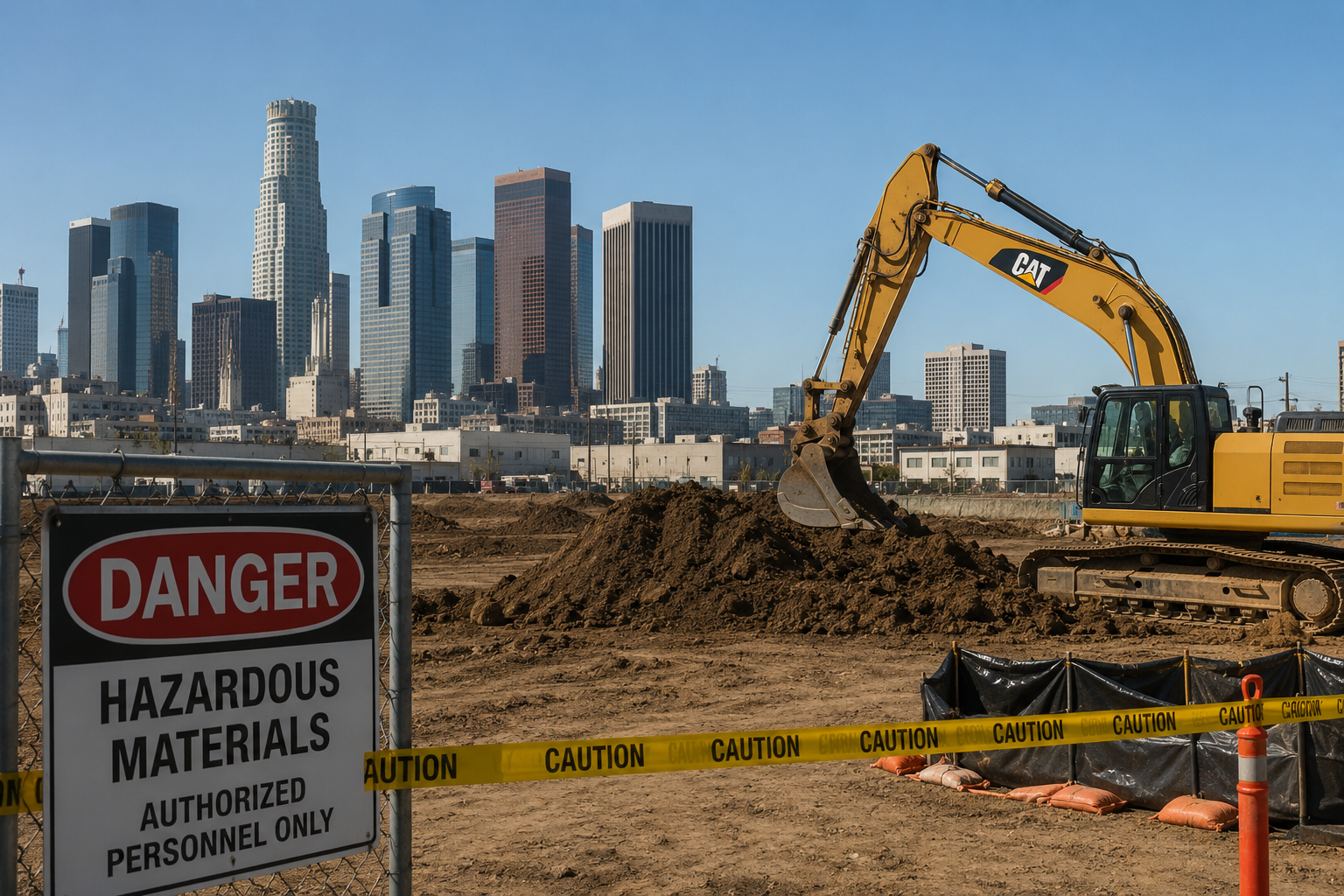
More than 16,000 structures were destroyed when the Palisades and Eaton fires tore through Los Angeles County in January 2025. By the time the smoke cleared, the region faced not only the largest peacetime rebuilding effort in California history — but a sprawling, poorly understood environmental contamination crisis buried in the very ground beneath people's feet. Now, 17 months later, communities in Pacific Palisades, Altadena, and Malibu are rebuilding at a pace, some without ever having tested the soil on which new foundations are being poured. Scientists and public health advocates are calling it a slow-motion catastrophe.
The core problem is chemical. Urban wildfires do not simply burn wood and vegetation. They incinerate the entire material content of modern homes: plastics, treated lumber, electronics, vehicles, solar panels, insulation, paints, solvents, and household chemicals. When these materials combust at high temperatures, they release a toxic cocktail of heavy metals, volatile organic compounds, dioxins, furans, polycyclic aromatic hydrocarbons (PAHs), polychlorinated biphenyls (PCBs), per- and polyfluoroalkyl substances (PFAS), asbestos fibers, and fine lead particles. Much of this airborne toxicity ultimately settles out of the atmosphere and deposits into the soil — creating concentrated hotspots of contamination that can persist for decades.
FEMA's Controversial Decision: No Post-Cleanup Soil Testing
The controversy at the heart of the LA contamination story is a decision by the Federal Emergency Management Agency and the Army Corps of Engineers to forgo standard post-remediation confirmatory soil testing. While Phase 1 hazardous material removal was completed — including ash cleanup and the removal of up to six inches of topsoil from destroyed properties — a peer-reviewed analysis in the Journal of Exposure Science and Environmental Epidemiology found that removing a single six-inch layer is insufficient protection. Wildfires create unpredictable contamination hotspots at varying soil depths; ash and debris disturbed during cleanup operations can drive contaminants deeper into the soil profile. The journal study called the approach inadequate for protecting public health, particularly for lead exposure in children.
California lawmakers pushed back hard. "FEMA's refusal to test for toxins in the soil after wildfire cleanup in Los Angeles County is unacceptable," said Assemblymember Friedman in a statement quoted by the Los Angeles Times. "Families deserve to know their homes are safe and free of dangerous chemicals. This is a break from decades of FEMA precedent — and it risks exposing entire communities to long-term health threats." The EPA has since launched an additional soil sampling initiative focused on lead — collecting samples at two depths below the cleanup excavation level — but critics say this comes too late for properties already under reconstruction.
What the Science Says About Lead and Urban Wildfire Ash
Lead is a particular focus of public health concern because there is no known safe level of exposure, especially for children. Lead was used extensively in paint manufactured before 1978, making older homes — of which there were many in Altadena and Pacific Palisades — a significant source of lead that becomes airborne and airborne-deposited during fires. After the 2021 Marshall Fire in Colorado, precise soil studies found elevated levels of lead, chromium, and copper scattered throughout burned neighborhoods. After the 2018 Camp Fire in Northern California, a California Air Resources Board analysis traced heavy metals traveling in smoke from Chico all the way to San Jose — over 180 miles away.
The exposure pathway is not limited to direct soil contact. Lead and other heavy metals in contaminated soil can become airborne as fine dust during dry conditions, construction activity, and wind events. Children are at the highest risk because they spend more time at ground level, are more likely to engage in hand-to-mouth behaviors, and absorb ingested lead at far higher rates than adults. The lead-contaminated dust created during the LA rebuild — from disturbed soil, construction debris, and unremoved ash at adjacent properties — is a pediatric health risk that neither FEMA, CalRecycle, nor the state has adequately quantified.
Who Is Responsible for Testing — and Who Is Paying
In the absence of federal mandates, soil testing responsibility has fallen to a patchwork of nonprofit groups, academic researchers, and county health departments. The California Department of Toxic Substances Control (DTSC) has issued guidance and coordinates with LA County on a drop-off soil testing program, prioritized for properties within the burn footprints of the Palisades and Eaton fires. The county's program focuses particularly on lead, chromium, and arsenic. Independent groups, including CAP.LA and USC researchers have conducted additional voluntary testing.
The broader question — whether rebuilding should be permitted without mandatory soil certification — remains politically charged. The fast-tracking of the rebuild was framed by state and federal officials as an act of compassion and urgency for fire victims. But environmental scientists argue that speed and safety are not mutually exclusive: that mandatory confirmatory soil testing could be completed within weeks and would protect both the families rebuilding and the children who will grow up on those properties for decades. "Testing only the upper layer may not capture the full extent of contamination," the Wildfire LA research collaborative noted in March 2026. "As a result, many parcels across Los Angeles County may not yet have a complete or accurate picture of what remains underground."
What LA Residents Should Do Right Now
Any homeowner, renter, or parent in a fire-affected neighborhood should not wait for a government mandate. Free or low-cost soil testing is available through LA County Public Health's drop-off program, CAP.LA and USC researchers. Before allowing children to play on soil near or adjacent to fire burn areas, have the soil tested for lead, chromium, and arsenic at a minimum. When in doubt, cover exposed soil with grass, bark, or pavers to reduce contact and dust generation. During any construction or grading activity on affected properties, residents on adjacent lots should minimize outdoor time, close windows, and use N95 masks when outside.
RELATED ARTICLES ON NATUREWORLDNEWS.COM
© 2026 NatureWorldNews.com All rights reserved. Do not reproduce without permission.


