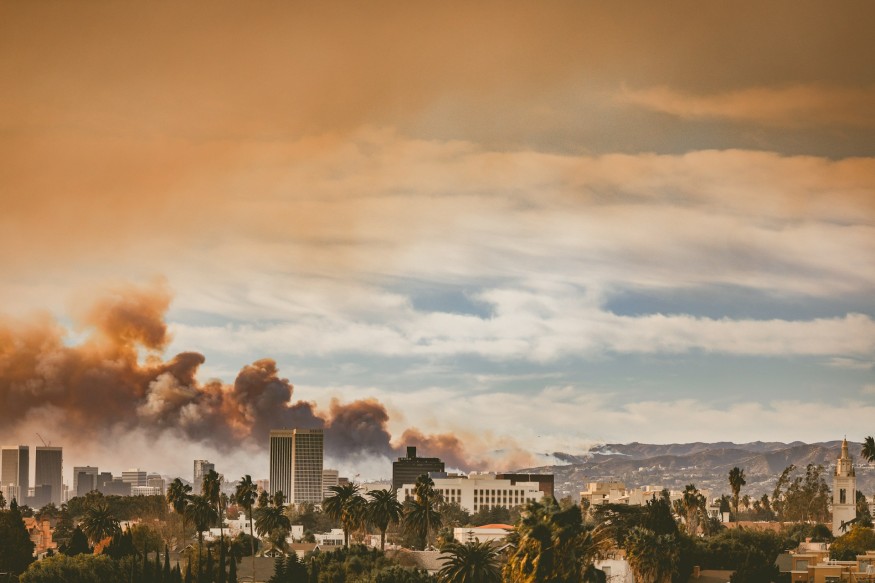
Los Angeles has had a rough spring. Just when residents thought the winter's catastrophic fire season was behind them, three separate wildfires ignited within days of each other in mid-May 2026 — and with them came a thick curtain of smoke that choked one of America's most densely populated metropolitan areas. The Sandy Fire near Simi Valley, the Bain Fire in Riverside County, and the Santa Rosa Island Fire in Santa Barbara County converged to create a regional air quality emergency that local officials scrambled to contain.
The numbers are sobering. According to the South Coast Air Quality Management District (SCAQMD), the Sandy Fire burned 1,698 acres and was only 5% contained as of May 19, the Bain Fire scorched 1,375 acres at 0% containment, and the Santa Rosa Island Fire tore through a staggering 16,942 acres at just 26% contained. The SCAQMD issued a smoke advisory covering Los Angeles, Ventura, Riverside, and San Bernardino counties — a combined population of over 18 million people — and extended it through Thursday evening, May 21, as weak winds offered little relief.
What the Air Was Actually Like
Officials measured widespread Moderate Air Quality Index (AQI) levels across the L.A. Basin, Catalina Island, the Inland Empire, and the Coachella Valley. But for residents near the fire corridors — from Simi Valley to the San Fernando Valley to Arcadia — conditions reached the Unhealthy for Sensitive Groups category or higher, according to the SCAQMD smoke advisory release. Coastal areas including Calabasas, Santa Monica, Malibu, Beverly Hills, and Pacific Palisades were also directly in the smoke's path.
The AQI scale, managed by the EPA's AirNow.gov platform, runs from 0 to 500. Zero to 50 is "Good"; 51–100 is "Moderate"; 101–150 is "Unhealthy for Sensitive Groups"; 151–200 is outright "Unhealthy"; 201–300 is "Very Unhealthy"; and anything above 300 is considered "Hazardous." During major wildfire events, PM2.5 levels in the L.A. Basin have been documented exceeding AQI 200, reaching genuinely dangerous concentrations even in typically cleaner coastal communities.
The primary pollutant in wildfire smoke is fine particulate matter, or PM2.5 — particles so tiny they penetrate deep into the lungs and can enter the bloodstream directly. Per the California Air Resources Board (CARB), the federal daily average limit for PM2.5 concentration is 35 micrograms per cubic meter. During the January 2025 fires, a monitor in Chinatown recorded a peak of 483.7 micrograms per cubic meter — nearly 14 times the federal limit. May's fires triggered the same regional machinery, reminding Angelenos that this is no longer a seasonal aberration.
Schools, Children, and the Outdoor Workers Being Left Behind
The SCAQMD urged schools and recreational programs to follow California's Department of Education guidelines for wildfire smoke events. Yet a persistent critique from public health advocates is that these advisories arrive reactively rather than proactively. Schools and parents are left scrambling to interpret real-time AQI readings from platforms like AirNow or the IQAir app — which can show meaningfully different numbers based on monitoring methodology — while outdoor workers, including landscapers, construction crews, and delivery drivers, have no institutional protection unless employers choose to act.
"If you're in an area with smoke pollution, you want to try to remain inside. Keep your windows and doors closed," said Scott Epstein with the South Coast AQMD, per FOX 11 Los Angeles. He added that outdoor exercise should be limited because physical exertion requires breathing significantly more air, dramatically increasing pollution intake. That guidance is practical for white-collar professionals working from home. For the millions of Angelenos who cannot choose to stay indoors, it is simply not actionable.
Spring Is Supposed to Be L.A.'s Clean Air Season — So Why Is This Happening?
Here is what makes this month's air crisis especially alarming: spring is historically L.A.'s best season for air quality. As noted by the US Air Quality Guide for Los Angeles, the March–May window traditionally brings cooler temperatures, diminished ozone formation, and dispersive spring winds that flush pollution from the basin. Winter inversion patterns break down. Fire season has not yet officially started.
And yet, here we are. Fires ignited in mid-May across multiple counties simultaneously, fueled by dry vegetation and a landscape that has become chronically more flammable over recent years. The L.A. region's geography — a coastal basin surrounded by mountains — makes smoke dispersion inherently difficult when winds are weak. The SCAQMD specifically cited "weak winds" as the reason the smoke advisory had to be extended multiple times through May 21.
What this tells us is that the old seasonal calendar for wildfire risk in Southern California no longer holds. The traditional peak of fire season — late summer and fall, driven by Santa Ana winds — remains the most dangerous window, as the January 2025 Palisades and Eaton fires devastatingly demonstrated. But fire is now a threat that Angelenos must factor into their daily calculations in any month. The infrastructure, public communication systems, and emergency protocols were not built for that reality.
A Conclusion That Demands Action
There is a clear and uncomfortable conclusion to be drawn from the data: Los Angeles is repeatedly caught off guard by the predictable. Fire risk is not a surprise. Smoke is not a surprise. The health consequences of PM2.5 are well documented by institutions including UCLA Health and CARB. What is lacking is not scientific understanding — it is political will and urban planning that actually accounts for a region that now faces wildfire smoke as a near-year-round public health hazard.
City and county leaders must expand mandatory smoke protection for outdoor workers, accelerate air filtration installation in public schools, and fund a public-facing alert system that goes beyond AQI numbers on a website. The advisories this May told millions of people to stay inside — without telling them how to do so safely or providing any support for those who couldn't. That gap between what officials recommend and what residents can actually do is where public health failures are born.
The Sandy Fire, Bain Fire, and Santa Rosa Island Fire will be contained eventually. But unless Los Angeles takes structural steps to prepare its 10 million residents for the next smoke event — which the AccuWeather 2026 Summer Forecast predicts will arrive on an elevated timeline this year due to developing El Niño conditions — the city will find itself issuing the same advisories, for the same reasons, all over again.
Sources & References
South Coast AQMD — May 19 Smoke Advisory | FOX 11 LA — Wildfire Smoke Advisory Extended | NBC Los Angeles — Smoke Advisory Extended
KTLA — Sandy Fire Smoke Blowing Into LA | LA County Dept. of Public Health — Air Quality Warning | UCLA Health — Air Quality After LA Fires
California Air Resources Board — Wildfire Smoke FAQ | IQAir — Los Angeles AQI Data | AirNow.gov — California Air Quality
Related Coverage on NatureWorldNews.com
→ California's Wildfire Season Is Getting Longer and Deadlier — Here's Why
→ PM2.5 Pollution: The Invisible Killer Hiding in Wildfire Smoke
→ Why Southern California's Fire Season Now Lasts All Year
→ How to Protect Your Family When Wildfire Smoke Hits Your City
→ The January 2025 L.A. Fires: A Full Damage and Environmental Impact Report
© 2026 NatureWorldNews.com All rights reserved. Do not reproduce without permission.


