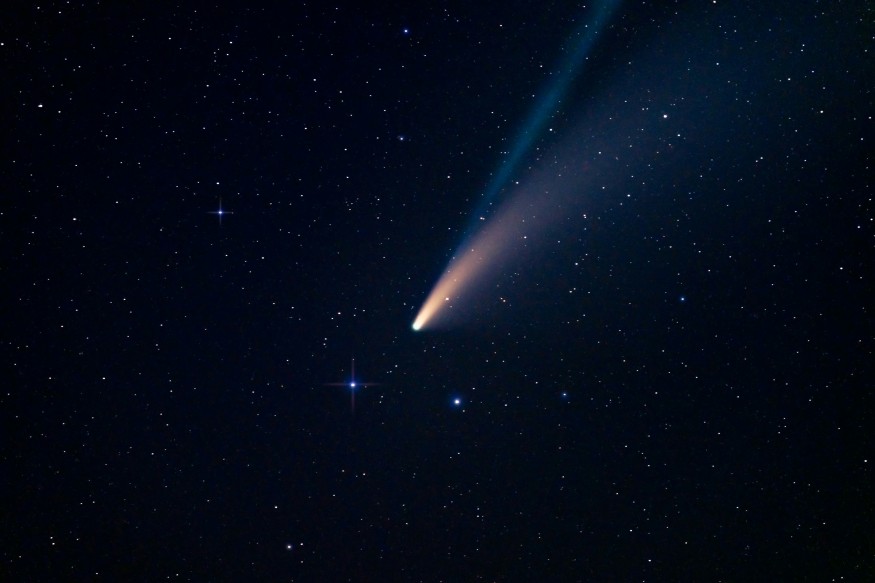
On February 10, 2026, Comet 29P/Schwassmann-Wachmann 1 erupted dramatically, brightening roughly 100 times its normal luminosity. This city-sized ice volcano comet spewed cryomagma in an explosive outburst, producing a rare spiral "snail shell" coma that reflected sunlight spectacularly in the constellation Leo. The extraordinary comet phenomenon ranks among the most significant eruptions of the past 25 years, following the October 2024 quadruple blast, which peaked at 300 times brighter than usual.
Comet 29P's 60-kilometer nucleus hosts multiple vents that release material at velocities of 0.9 km/s, with rotation modulating activity while cold nights reseal the vents. As one of the most active centaur objects in the solar system, it provides a unique opportunity to study ice volcano comet behavior in detail, combining spectacular visual display with rare scientific insight.
Ice Volcano Comet Cryovolcanic Mechanics
The internal dynamics of Comet 29P reveal how ice volcano comets operate at great distances from the Sun. Solar radiation heats the cryomagma inside the nucleus, composed of frozen CO, methane, ethane, propane, and carbon dioxide. As these ices sublimate, pressure builds beneath the comet's icy crust until it fractures explosively, ejecting material into space.
The resulting coma often expands asymmetrically when the nucleus rotation is misaligned with the interior, producing the distinct spiral "snail shell" appearance rather than a uniform cloud. Unlike long-period cryovolcanic comets that erupt primarily near perihelion, 29P remains at 5.7–6.3 AU, with roughly 20 eruptions per year. Sunward vents open under solar heating, while nights allow fissures to reseal, producing both minor and major eruptions, making the comet a continuous subject of observation in astronomy news 2026.
Glowing Comet Phenomenon Spiral Formation
The Comet eruption revealed an unusual spiral coma resembling a fossil ammonoid. Astrophotographers Eliot Herman in Chile and Anthony Kroes in Wisconsin captured images showing a dense core expanding from 15″ to 45″ over three days, while the magnitude brightened from 13.5 to 11.5. The spiral results from the nucleus rotating relative to interior cryomagma layers, forcing ejected material into a helical trajectory.
This dynamic behavior mirrors features observed in other cryovolcanic comets, including 12P/Pons-Brooks' "devil horns" and the multi-jet activity of 3I/ATLAS. Minor aftershocks, such as the February 15 reinjection of cryomagma, can reform or expand the spiral, making the comet's appearance continually evolving and adding to its allure for both observers and researchers.
Comet Eruption 2026 Observing Guide
Comet 29P reached peak visibility for observers using 8–10″ telescopes or binoculars in the constellation Leo, approximately 20° above the horizon between 10:00 and 10:30 pm local time. Its westward motion and nightly expansion require careful tracking to catch the most dramatic stages of the eruption.
Amateur astronomers noted the dense, cotton-ball-like pseudo-nucleus, which appeared nearly stellar under high magnification. Richard Miles of the British Astronomical Association emphasized monitoring for aftershocks, as smaller eruptions often follow major outbursts. The comet's 14.87-year orbit and 60.4-kilometer diameter make it one of the largest centaur objects, yet it remains safely distant from Earth, with a minimum approach of 4.78 AU.
Astronomy News 2026 Cryovolcano Comparisons
Cryovolcanism in comets is rare, and 29P's consistent activity distinguishes it from other icy objects. Comparisons with 12P/Pons-Brooks' devil comet horns, C/2024 E1 Wierzchoś' naked-eye daytime visibility, and C/2025 R3 PanSTARRS' binocular brightening highlight the diversity of eruptive behavior. While most long-period cryovolcanic comets erupt only near perihelion, 29P demonstrates that repeated outbursts can occur even in relatively stable solar distances.
Studying these events allows scientists to understand the mechanisms driving cryomagma dynamics, the effects of vent geometry, and how nucleus rotation influences ejection patterns. Such comparisons also clarify the rarity and significance of 29P's spiral coma, making it a natural laboratory for understanding cryovolcanic activity in the solar system.
What the 29P Outburst Reveals About Ice Volcano Comets
The February 2026 eruption of Comet 29P provides unprecedented insight into cryovolcanic activity. It confirms that solar heating at distances beyond Jupiter can still trigger explosive sublimation of volatile ices. The resulting pressure leads to fissure formation and massive cryomagma ejection, producing observable changes in coma brightness and morphology.
The snail-shell spiral highlights the importance of rotational dynamics, showing how asymmetrical venting produces intricate patterns in the ejected material. Observing 29P over multiple nights allows astronomers to capture aftershocks and minor reinjections of cryomagma, deepening understanding of these rare and dynamic icy bodies.
Ice Volcano Comet 29P Illuminates Solar System Mysteries
Comet 29P/Schwassmann-Wachmann 1's recent eruption underscores the complexity and unpredictability of ice volcano comets. Its glowing spiral coma, rapid ejection of material, and sequential aftershocks provide a detailed view of interior cryovolcanic mechanics. Continuous monitoring helps researchers understand the interplay between nucleus rotation, vent geometry, and sublimating ices.
As one of the most active centaur objects, 29P also challenges existing assumptions about cometary behavior at great distances from the Sun. Each eruption not only offers a spectacular visual for astronomers but also advances knowledge of small-body evolution, volatile-driven dynamics, and the broader mechanisms shaping icy objects in the solar system. Future observations of 29P promise to uncover even more about these enigmatic and powerful cosmic phenomena.
Originally published on Science Times
© 2026 ScienceTimes.com All rights reserved. Do not reproduce without permission. The window to the world of Science Times.


